
Article written for In the Loop magazine.
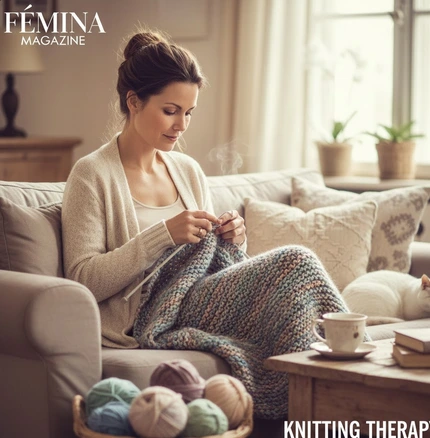
Knitting is making a major comeback, and its benefits extend far beyond simply creating a handmade object. Originally invented to meet practical needs, then becoming the quintessential hobby of our mothers and grandmothers, knitting has taken on a whole new dimension today. Its positive impact on our health and social lives is so widely praised that we now speak of “knitting therapy.” In many ways, knitting is the new yoga.
According to Fiona Clarke, a health promotion specialist at NHS Highland, knitting allows us to slow down and has powerful anti-stress properties—something many knitters can attest to. In fact, some British companies even encourage knitting among their employees to improve productivity and workplace well-being.
Monica Baird, a pain specialist interviewed by Catherine Cordonnier for Top Santé, explains that “knitting alters brain chemistry by lowering cortisol levels (the stress hormone) while boosting the production of dopamine and serotonin, the molecules of well-being.”
Even Jacques Plante, the legendary goaltender for the Montreal Canadiens, knitted before and after Stanley Cup games between 1956 and 1960, as he found the practice had a profound calming effect.
Renée Blixt, a member of the Crochet Guild of America and the Knitting Guild of America, adds that knitting helps us focus on the big picture rather than getting bogged down in the details. Every stitch worked is part of a larger whole. Understanding a pattern requires a global vision, as well as an understanding of all the intermediate steps that lead to the final result. Focusing on the goal rather than a single detail allows for a better perspective on a situation and a more effective way to resolve it.
Furthermore, knitting can have a spiritual dimension, as seen with the talit or Jewish prayer shawl. This is a large woolen rectangle with fringes that some practitioners wrap around themselves during prayer. In a more esoteric sense, some prayer shawls are created through spiritual rites (prayers and blessings) intended to imbue the garment with healing and benevolent properties.
Additionally, this hobby requires a level of concentration akin to meditation. Once a stitch pattern is fully memorized, the mind is free to wander peacefully. The repetitive motion of the needles becomes natural and activates the same areas of the brain as yoga, allowing the knitter to experience the benefits of mindfulness. Dr. Bendon, Director of the Brain Institute at Harvard Medical School, describes it as “a way to put the body into relaxation.” Thus, knitting helps soothe tensions and health issues related to anxiety.
My own knitting therapy
Personally, my knitting follows me everywhere and has become an indispensable part of my life.
It started during some difficult periods at work. In those moments, I would count down the minutes until my lunch break just so I could knit a few rows! It allowed me to calm down, clear my head, and keep my hands busy so I wouldn’t dwell on the morning’s problems. It was also during this time that I joined a knitting group and started my blog.
Since then, whenever I visit an unfamiliar place or have a business meeting, I always bring my needles along in case I face a stressful—or worse, boring—situation (what if my client stands me up?).
Ultimately, my knitting has become an anchor that reassures me, much like a child is comforted by a security blanket. Even if I rarely actually knit in those situations, I feel better just knowing that there is a “Plan B” hiding in my bag, and that once my daily obligations are over, I can devote myself to it. In those moments, I feel like a “masked knitter”: appearing ordinary on the outside, while thinking of only one thing—my yarn and needles!
Moreover, knitting is a great weapon against boredom. If your job isn’t your passion, nothing stops you from imagining your next pattern or even sketching it out on the corner of a desk, away from prying eyes!
And if you work in an environment where no one takes the time to thank or congratulate you for your efforts, knitting can (partially) fill that void of ingratitude. Finishing a project is incredibly rewarding. First, because it generally earns the admiration of loved ones, and second, because you have undertaken and completed something concrete that is a skill many people don’t possess. The fruit of your labor is visible right before your eyes, which isn’t always the case in certain professional fields.
So, if you’re feeling unhappy at work, I have one word for you: knit!
The social benefits of knitting
Knitting is also about belonging to a community.
This community can be virtual, through blogs or platforms like Ravelry (a community website for knitting and crochet with over 2 million members).
But it also involves real-life connections that happen regularly in every major city through “knit cafes,” which are becoming increasingly popular. It is a way for many people—both men and women—to escape their daily routine and forge new friendships through a shared passion. Not to mention social-impact groups that create clothes and blankets for charities.
Reading suggestion: The novel Blossom Street by Debbie Macomber.
When Lydia Hoffman opens her shop in an old neighborhood of Seattle one April morning, she realizes her lifelong dream. Through the wool she sells and the knitting workshops she leads, she shares her zest for life—a desire to move forward step by step, against all odds, which has guided her since she overcame a serious illness. Her little shop on Blossom Street soon becomes a sanctuary for three women—Jacqueline the socialite, Carol the young bride longing for a child, and Alix the rebel. Despite their differences, they discover they are closer than they thought in their suffering, their hopes, and their desires for love and motherhood.
Knitting: A tool for weight loss or quitting smoking?
Knitting can actually be a helpful aid for weight loss. As Pauline from the Mercredi et Compagnie blog shares, knitting during drinks with friends prevents you from mindlessly snacking on appetizers without anyone even noticing!
But the practice isn’t just good for dieting; it can also help people quit smoking. After a heartbreak, Elisabeth Ollieric decided to quit smoking and took up knitting to replace the repetitive hand-to-mouth gesture of a cigarette with that of knitting needles. Because this method worked for her, she created the “Pénéclop’ attitude” kit (priced around $30), which provides everything needed to start a scarf that you finish as your urge to smoke disappears.
A new way of living?
All these examples show that knitting brings numerous medical and social benefits. It allows us to reshape our habits, escape the mundane, and perform acts of kindness. Whether practiced with friends or alone, whether viewed as spiritual or meditative, knitting improves our daily lives. It is a compulsive activity that is far less harmful than smoking or overeating; it occupies the hands and mind, allowing us to recenter ourselves.
At least, it worked for me. Will it work for you?
Sources: http://www.orilliapacket.com/ArticleDisplay.aspx?e=3098129&archive=true http://renee-blixt.suite101.com/knitting-as-the-new-yoga-a33393 http://elisabethollieric.prosite.com/51068/452696/styles/le-kit-pnclop-attitude
See also